Draw a 250 Mile Circle Around Canon City Colorado
| | ||||
|---|---|---|---|---|
| U.S. Road 87 | ||||
| I-25 and United states 87 highlighted in cherry-red | ||||
| Route information | ||||
| Maintained by CDOT | ||||
| Length | 298.87 mi[1] (480.98 km) | |||
| Existed | 1958–present | |||
| Major junctions | ||||
| South end |    I-25 / The states 85 / United states of america 87 near Trinidad I-25 / The states 85 / United states of america 87 near Trinidad | |||
| Major intersections |
| |||
| North end | I-25 / Usa 87 near Wellington | |||
| Location | ||||
| State | United States | |||
| Land | Colorado | |||
| Counties | Las Animas, Huerfano, Pueblo, El Paso, Douglas, Arapahoe, Denver, Adams, Broomfield, Weld, Larimer | |||
| Highway system | ||||
| ||||
| ||||
| ||||


 The states 160 at Trinidad and Walsenburg
 The states 50 in Pueblo
 US 24 in Colorado Springs
 SH 470 / E-470 in Solitary Tree
 I-225 in Denver
 U.s. 285 in Denver
 US 40 / United states of america 287 in Denver

 I-76 in Northward Washington
 I-270 / US 36 in Welby
 United states of america 34 in Loveland
 SH 26
SH 26 SH 86
SH 86 SH 88
SH 88In the United states state of Colorado, Interstate 25 (I-25) follows the northward–s corridor through Colorado Springs and Denver. The highway enters the state from the north almost Carr and exits the state near Starkville. The highway also runs through the cities of Fort Collins, Loveland, and Pueblo. The route is concurrent with U.S. Route 87 (Us 87) through the entire length of the state. I-25 replaced Usa 87 and well-nigh of Usa 85 for through traffic.
Historical nicknames for this road accept included the Valley Highway (through Denver), Monument Valley Highway (through Colorado Springs), and the Pueblo Freeway (through Pueblo). Within El Paso County, the route has been dedicated as the Ronald Reagan Highway.[2] [3] In Pueblo County, the road is called John F. Kennedy Memorial Highway.
I-25 is likewise considered to be part of the unofficial Pan-American Highway.[4]
Route clarification [edit]
New Mexico state line to Pueblo [edit]
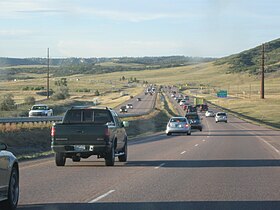
Following the Santa Fe Trail from New United mexican states, I-25 enters Colorado while concurrent with US 85 and US 87. Information technology is a typical iv-lane Interstate Highway, and its entire route in Colorado lies close to the e side of the Rocky Mountains. The route turns from n to west-northwest as I-25 serves Wootton. Later leaving Wootton, I-25 turns back up north and bypasses nearly the east side of the Trinidad Lake State Park, home of the Trinidad Lake.
Trinidad, a city virtually the Trinidad Lake, is the get-go major city that lies forth I-25. For the next 30 miles (48 km), I-25 continues north through the rural areas of Colorado until it reaches the pocket-sized urban center of Walsenburg, where State Highway 25C (Interstate 25 Concern, I-25 Bus.) junctions with US 160. I-25 then continues in a north-northwest direction until it bypasses the Orlando Reservoir, then turns north from there until information technology reaches Colorado Metropolis. In Colorado City, I-25 interchanges with the e end of the Frontier Pathways Scenic and Historic Byway (SH 165) at leave 74.
Later leaving the urban center, I-25 follows in a north-northeast orientation until it reaches the St. Charles Reservoir just before entering the city of Pueblo, with the outset get out within the southern city limits of Pueblo at leave 94.[5] The Arkansas River in Pueblo serves as a feeder to the Lake Pueblo State Park, home of Pueblo Lake, which is located to the west of the western city limits of Pueblo.[six]
Pueblo to Denver [edit]

I-25 northbound at the U.s.a. 285/SH 30 interchange in Denver
After leaving Pueblo, I-25 continues up north with the Union Pacific Railroad line paralleling closely to the route on the correct side after interchanging with Porter Draw at exit 106. By exit 119, the Fountain Creek joins forth and travels parallel with I-25, and continues all the style to the Fountain Creek Regional Park in Widefield. I-25 gradually turns from a general north management to the due north-northwest and serves the demography-designated identify of Buttes at exit 122.

Cheyenne Mountain, as seen from I-25 near Fort Carson. Note the communications antennas at the top, which are radio antennas for stations broadcasting in Colorado Springs.
As soon as US 85 leaves I-25 at exit 128, I-25 enters the city limits of Fountain. Basically, I-25 serves equally the border betwixt the western metropolis limits of Fountain on the east side of I-25 and Fort Carson on the due west side. Leave 132 (SH 16) serves the northward side of the Fountain Creek Regional Park as well equally the entrance to Fort Carson and connects to SH 21 (Powers Boulevard), the eastern bypass for the Colorado Springs metro area. Past the time I-25 reaches get out 138, the road crosses into the city limits of Colorado Springs, where the stack interchange with US 24 at leave 139 serves the Evergreen Cemetery and Prospect Lake. I-25 turns w at exit 140, along with Fountain Creek, where it interchanges with United states 85, US 87, and State Highway 25 Business organization (Pike 25 Motorcoach., I-25 Bus.). I-25, over again, turns back north past leave 141. Swinging around the west side of downtown Colorado Springs at exit 142,[5] and to the north of the metropolis lies the Colorado College, and is served at exit 143 (Uintah Street). Continuing north and northeast, the highway intersects the north terminus of State Highway 25 Passenger vehicle. and US 85. The Interstate leaves Colorado Springs between exits 153 and 156, where I-25 enters the United States Air Force Academy, going through the east side of the institution.

Map showing I-25 and nearby freeways and major highways in the Denver Metropolitan area
I-25 leaves El Paso Canton and enters Douglas County at Monument Loma, peak seven,352 ft (2,241 m), n of Monument. I-25 and then continues north through more rural and hilly areas eastward of the Rocky Mountains until reaching Castle Rock at exit 181. I-25 continues through rural and hilly portions of Douglas County until interchanging with E-470, the fractional beltway of Denver equally the price road serves the Centennial Drome and the much larger Denver International Airport.
After entering Arapahoe County, I-25 cuts through the Denver Technological Middle (DTC) betwixt Dry Creek Road and Belleview Avenue (exits 196 and 199). I-25 enters Denver at the I-225 interchange, a spur that detours motorists to I-70 through Aurora, at leave 200. I-25 turns in a westerly direction between Evans Avenue (go out 203) and Colorado Boulevard (exit 204). University of Denver lies just to the south of the Interstate at leave 205. It and so turns dorsum north after exit 207. I-25 curves effectually the westward side of downtown Denver,[five] where it tin exist accessed past I-70 Bus. at exit 210.[5] I-25 then interchanges with I-70 at exit 214 right before leaving the City and Canton of Denver.[6]
Denver to Wyoming state line [edit]
As I-25 leaves Denver, the route continues upwardly north through unincorporated areas of Adams County and interchanges with I-76, I-270, and the Denver-Boulder Turnpike (Usa 36). Due to the complexity of this triangle-shaped interchange, information technology was known to be one of many malfunction junctions throughout the Us. Across that interchange, the Interstate enters the northern suburbs of the Denver metro area, such equally Thornton and Northglenn, and at leave 220, I-25 slips its way through a narrow path between the Badding Reservoir (west side) and the Croke Lake (east side). Development begins to drop off subsequently exit 223 (120th Avenue) after continuing north into Westminster and eastern Broomfield.
At exit 228, I-25 interchanges with the northern terminuses of E-470 and Northwest Parkway at a stack interchange, with the Larkridge Mall just to the north, served past 160th Avenue (SH 7). As I-25 continues north, it moves through rolling subcontract and grasslands with the Forepart Range and high mountains conspicuously visible to the westward while passing through a medley of lakes and reservoirs. It stays generally flat with few moderate climbs in elevation, while also serving smaller cities like Dacono and Firestone to the east and Longmont to the west. This stretch of I-25 in northern Colorado as well has big amounts of truck traffic between SH 7 and Wyoming. After some time in the rural farmlands, the Interstate enters the Fort Collins–Loveland metro surface area at exit 255, serving Loveland and Greeley to at exits 255 and 257, Windsor at exit 262, and continuing north to the Fort Collins urban center limits south of Harmony Route. The highway runs on the eastern side of Fort Collins, serving Colorado Land Academy at exits 268 and 269 (which is also the most directly route to downtown). Later leave 271, I-25 leaves Fort Collins and rolls into more than rural grasslands past Wellington. Exits as well become few and far between from here to Wyoming as well after gradually turning north-easterly toward the country line.[5] [six]
History [edit]
Ancestors and early freeways [edit]
Colorado had begun planning of a modern intercity route along the Front Range every bit early as 1944, well before the national movement toward an Interstate Highway arrangement.
SH 1, an unpaved route, was completed between Denver and Pueblo by 1919. Average travel time between Pueblo and Colorado Springs on this route was approximately ii.five hours (or a full viii.5 hours from Pueblo to Denver). This route was upgraded with the help of the federal government to go The states 85 and United states of america 87 past 1930, now paved in concrete and shortening the travel time between Pueblo and Colorado Springs to just one hour.
The cities of Denver (in 1948) and Pueblo (in 1949) were kickoff to begin building multilane highway segments along the route of what would eventually go I-25. Construction follows an earlier segment of the Colorado and Southern Railway. Denver's segment was originally known as the Valley Highway and was completed by 1958. The city of Colorado Springs followed a similar theme with their Monument Valley Freeway, begun in 1955 and completed past July 1960. Pueblo's section—the Pueblo Expressway—was complete by July 1959.[three]
Interstate completion [edit]
As the national Interstate Highway System began to take shape, actual "interstate" connections began to be made. Wyoming came first in 1964, building a ix-mile (14 km) link n to Cheyenne that was connected to Colorado's 17-mile (27 km) stretch.
Linking to New Mexico in the south would show more problematic equally the planned road had to stretch over Raton Pass, and its accompanying 1,800-foot (550 m) elevation change, within only 13 mi (21 km). Once once again, US 85 and US 87 were used, but it had to exist regraded in places to come across Interstate design guidelines. Construction began in 1960, with a link to the city of Trinidad completed by 1963. The Trinidad Segment (as CDOT now calls the Raton Pass span) was not fully completed until 1968.
The last segment of the Colorado portion of I-25, connecting the cities of Walsenburg and Trinidad, was completed during 1969. This meant that iv lanes of high-speed, nonstop freeway were finally open up for a total 305 miles (491 km) from New Mexico north to Wyoming.[3] [7]
Modern expansion [edit]
As both population and traffic increased in Colorado during the 1990s and 2000s, the Colorado Department of Transportation has planned and completed major improvements for the metropolis corridors along I-25.
T-Rex (Denver) [edit]

The kickoff of these was Transportation Expansion (T-King), which widened and expanded near 17 miles (27 km) of both I-25 and the I-225 bypass in the Denver Metropolitan Area as well equally calculation various pedestrian and aesthetic improvements. T-REX was besides instrumental in expanding Denver'due south RTD light rail lines to connect outlying communities beyond the city and county of Denver, adding nineteen miles (31 km) of new routes.[seven] [8]
Starting in early on 2004, the T-REX projection was completed during 2006 at a cost of $ane.67 billion, nether its projected budget and two years ahead of its originally scheduled conclusion. It has been hailed equally a "model for other cities to follow" and "ahead of the curve nationally" by federal transportation and transit authorities.[8]
COSMIX (Colorado Springs) [edit]

As T-REX began to wrap upward, CDOT's next major endeavour began with Colorado Springs Metro Interstate Expansion (COSMIX). It could be argued that COSMIX was even more important to Colorado'south interests than T-REX had been, since the Colorado Springs corridor of I-25 had seen immense growth over the by four decades, and experienced major choke points all forth the 16-mile (26 km) corridor from exit 135 (Academy Blvd) in the south to go out 151 (Briargate Pkwy) in the north. Originally carrying around 8500 vehicles per day in 1960, usage of the old Monument Valley Freeway had grown to an average of 100,000 vehicles per twenty-four hour period by 2005.[9]
The major goals of COSMIX, which began in 2005 and was completed a year and four days alee of schedule at the very terminate of December 2007, were a general expansion and widening of the corridor to three lanes in each management throughout the city, as well as the reconstruction of ii main interchanges (at Bijou Street virtually downtown Colorado Springs, and at Rockrimmon Boulevard and North Nevada Artery in the urban center's growing north side).[10] Originally estimated at $225 million, on delivery, COSMIX cost only $150 million, approximately $20 million of which involved land acquisition costs.
COSMIX was the commencement funded portion of a larger program for I-25 improvements every bit detailed in an Environmental Assessment approved by CDOT and FHWA in 2004. A 2d phase resulted in the widening of the 12-mile (19 km) segment from Woodmen Route (go out 149) to Monument (get out 161) to six lanes and addition of auxiliary lanes at busy interchanges. The Air Force Academy interchange (exit 156) was reconfigured to include just one go out, instead of A/B, and features two new roundabouts for North Gate Boulevard. The widening and paving was completed in December 2014.[eleven]
An EA-recommended improvement non included in COSMIX due to funding limitations was the reconstruction of the I-25 interchange at Cimarron Street (US 24 West). CDOT completed this project in belatedly 2017.
Future [edit]
As of October 2020[update], a 7-mile (11 km) segment of I-25 through Pueblo is currently under construction. Enhancements include the widening of two bridges, noise wall installation, the softening of curves for better safety, and the addition of acceleration and deceleration lanes.[12] The $69 million projection was expected to finish in Spring 2019.[xiii]
At that place is much controversy surrounding the future of I-25 in northern Colorado (SH vii in Broomfield to SH 14 in Fort Collins). Suggestions from adding cost lanes to general expansion to 6 lanes from the two lane bottleneck at SH 66 to SH fourteen and adding multimodal transportation options have been discussed. The future of the highway remains in question as funding is limited, and understanding is express also. The I-25 corridor in Weld and Larimer counties is becoming increasingly heavy with traffic, and something will take to be done soon.[xiv]
In Colorado Springs, SH 21 (Powers Blvd.) is currently getting extended past SH 83 to its official northern terminus at I-25. This projection provides an easier featherbed around the north cease of the boondocks and volition also help connect Voyager Pkwy traffic to the Interstate. Powers Blvd. will eventually become a throughway featherbed of the Colorado Springs metro area. The construction is in two phases, I-25 is involved in phase 1, where a new directional T-interchange (Y-interchange) will be built near get out 156 at Due north. Gate Blvd. betwixt milemarkers 149 and 151. The interchange was completed in summertime 2021.[15] [16]
The Gap is an xviii-mile (29 km) stretch of I-25 from south of Castle Rock to Monument, in both Douglas and El Paso counties. It is the only iv-lane section of I-25, connecting Colorado's two largest cities, Denver and Colorado Springs. Over the years, congestion, crashes, and delays have grown due to population growth and more people using the road. Efforts to improve these weather are underway, and the projection is slated to be completed in 2022 with a cost of $350 million, with contributions from Douglas and El Paso counties, Pikes Height Rural Transportation Authorization and a federal INFRA grant.[ commendation needed ]
Go out list [edit]
[edit]
Auxiliary routes [edit]
| Interstate 225 | |
|---|---|
| Location | Aurora |
| Length | 12 mi[19] (19 km) |

In Colorado, I-25 has only one auxiliary route. Interstate 225 (I-225) is a 12-mile-long (19 km) spur route located within the Denver Metro Area. It runs from its parent highway from the Denver Tech Center to I-70 north of Aurora. Information technology is an eastern bypass for travelers on I-25 looking to avert Downtown Denver traffic and likewise provides direct connectedness to Denver International Aerodrome for the southern suburbs of Denver. It is the only auxiliary route for I-25 as at that place are no other routes in Wyoming and New Mexico.
Business routes [edit]
| Interstate 25 Business | |
|---|---|
| Location | Aguilar, Walsenburg |

Interstate 25 also has 2 active business routes inside the state. In Aguilar, the town is connected to the freeway by Business Spur 25, which runs along Lynn Route and Walsenburg is served by Business Loop 25. There were iii one-time routes that ran through Trinidad, Colorado Springs, and Castle Rock.
References [edit]
- ^ a b Colorado Department of Transportation, Highway Data Archived July 14, 2011, at the Wayback Machine, accessed October 2007: note that not every interval between mileposts is exactly a mile, explaining why more exits than expected are at the exact milepost
- ^ Ronald Reagan Presidential Foundation & Library Archived July 25, 2008, at the Wayback Auto
- ^ a b c "Interstate 25". Dot.state.co.united states of america. Retrieved Nov 27, 2011.
- ^ Sierra County Economical Evolution Organization. "Transportation and Highways". Archived from the original on September 7, 2007. Retrieved February 2008.
- ^ a b c d e The Road Atlas (Map). Rand McNally. 2006. p. 32.
- ^ a b c Google Maps street maps and USGS topographic maps, accessed February 2008 via ACME Mapper
- ^ a b Kuennen, Tom, ed. Interstate 50: l Years of the Dwight D. Eisenhower National System of Interstate and Defence Highways. 2006: Faircount. pp 118-119. ISBN unavailable.
- ^ a b "Metro Denver'southward multi-modal T-King takes last step - Metro Denver Economic Development Corporation". Metrodenver.org. Archived from the original on December 15, 2011. Retrieved November 27, 2011.
- ^ Kuennen, Tom, ed. Interstate 50: 50 Years of the Dwight D. Eisenhower National Organisation of Interstate and Defence force Highways. 2006: Faircount. pp 118-119. ISBN unavailable.
- ^ "Progress of Projection". Cosmixproject.com. Archived from the original on January 13, 2010. Retrieved November 27, 2011.
- ^ "Archived re-create". Archived from the original on October 17, 2014. Retrieved October xi, 2014.
{{cite web}}: CS1 maint: archived copy as title (link) - ^ Miguel, Michelle (April 16, 2015). "Structure on I-25 through Pueblo starts this summer". KRDO . Retrieved February 25, 2019.
- ^ "SB I-25 to close overnight in Pueblo as part of Ilex projection". KOAA.com. January 15, 2019. Retrieved February 25, 2019.
- ^ "North I-25 (Denver to Wyoming)". coloradodot.info.
- ^ "I-25/Powers Boulevard Interchange: About". Retrieved December 31, 2020.
- ^ "CO 21 Research Parkway Interchange Study". codot.gov . Retrieved Dec 31, 2020.
- ^ "I-25 & Powers Boulevard Interchange: About". Archived from the original on September 26, 2020. Retrieved April half-dozen, 2021.
- ^ "Crystal Valley Interchange". Castle Rock, CO - Official Website. Boondocks of Castle Rock and its representatives. Retrieved August 2, 2020.
- ^ "Highway Information Explorer". Colorado Section of Transportation. Retrieved Apr 1, 2022.
External links [edit]
Route map:
KML is from Wikidata
- Colorado Section of Transportation (CDOT)
- COSMIX (CDOT projection; website no longer existence updated)
- Due south I-25 Corridor: Lincoln Avenue through Castle Rock (CDOT project)
- The N Twoscore (CDOT project)
- I-25 Trinidad (CDOT projection)
- The New Pueblo Freeway (proposed CDOT project)
Source: https://en.wikipedia.org/wiki/Interstate_25_in_Colorado

Post a Comment for "Draw a 250 Mile Circle Around Canon City Colorado"